

Getty Images
Google has an announcement today: It’s not going to do something it has thought about, and tinkered with, for quite some time.
Most people who just use the Chrome browser, rather than develop for it or try to serve ads to it, are not going to know what “A new path for Privacy Sandbox on the web” could possibly mean. The very short version is that Google had a “path,” first announced in January 2020, to turn off third-party (i.e., tracking) cookies in the most-used browser on Earth, bringing it in line with Safari, Firefox, and many other browsers. Google has proposed several alternatives to the cookies that follow you from page to page, constantly pitching you on that space heater you looked at three days ago. Each of these alternatives has met varying amounts of resistance from privacy and open web advocates, trade regulators, and the advertising industry.
So rather than turn off third-party cookies by default and implement new solutions inside the Privacy Sandbox, Chrome will “introduce a new experience” that lets users choose their tracking preferences when they update or first use Chrome. Google will also keep working on its Privacy Sandbox APIs but in a way that recognizes the “impact on publishers, advertisers, and everyone involved in online advertising.” Google also did not fail to mention it was “discussing this new path with regulators.”
Why today? What does it really mean? Let’s journey through more than four and a half years of Google’s moves to replace third-party cookies, without deeply endangering its standing as the world’s largest advertising provider.
2017–2022: FLoC or “What if machines tracked you, not cookies?”
Google’s big moves toward a standstill likely started at Apple headquarters. Its operating system updates in the fall of 2017 implemented a 24-hour time limit on ad-targeting cookies in Safari, the default browser on Macs and iOS devices. A “Coalition of Major Advertising Trade Associations” issued a sternly worded letter opposing this change, stating it would “drive a wedge between brands and their customers” and make advertising “more generic and less timely and useful.”
By the summer of 2019, Firefox was ready to simply block tracking cookies by default. Google, which makes the vast majority of its money through online advertising, made a different, broader argument against dropping third-party cookies. To paraphrase: Trackers will track, and if we don’t give them a proper way to do it, they’ll do it the dirty way by fingerprinting browsers based on version numbers, fonts, screen size, and other identifiers. Google said it had some machine learning that could figure out when it was good to share your browsing habits. For example:
New technologies like Federated Learning show that it’s possible for your browser to avoid revealing that you are a member of a group that likes Beyoncé and sweater vests until it can be sure that group contains thousands of other people.
In January 2020, Google shifted its argument from “along with” to “instead of” third-party cookies. Chrome Engineering Director Justin Schuh wrote, “Building a more private Web: A path towards making third party cookies obsolete,” suggesting that broad support for Chrome’s privacy sandbox tools would allow for dropping third-party cookies entirely. Privacy advocate Ben Adida described the move as “delivering teeth” and “a big deal.” Feedback from the W3C and other parties, Schuh wrote at that time, “gives us confidence that solutions in this space can work.”
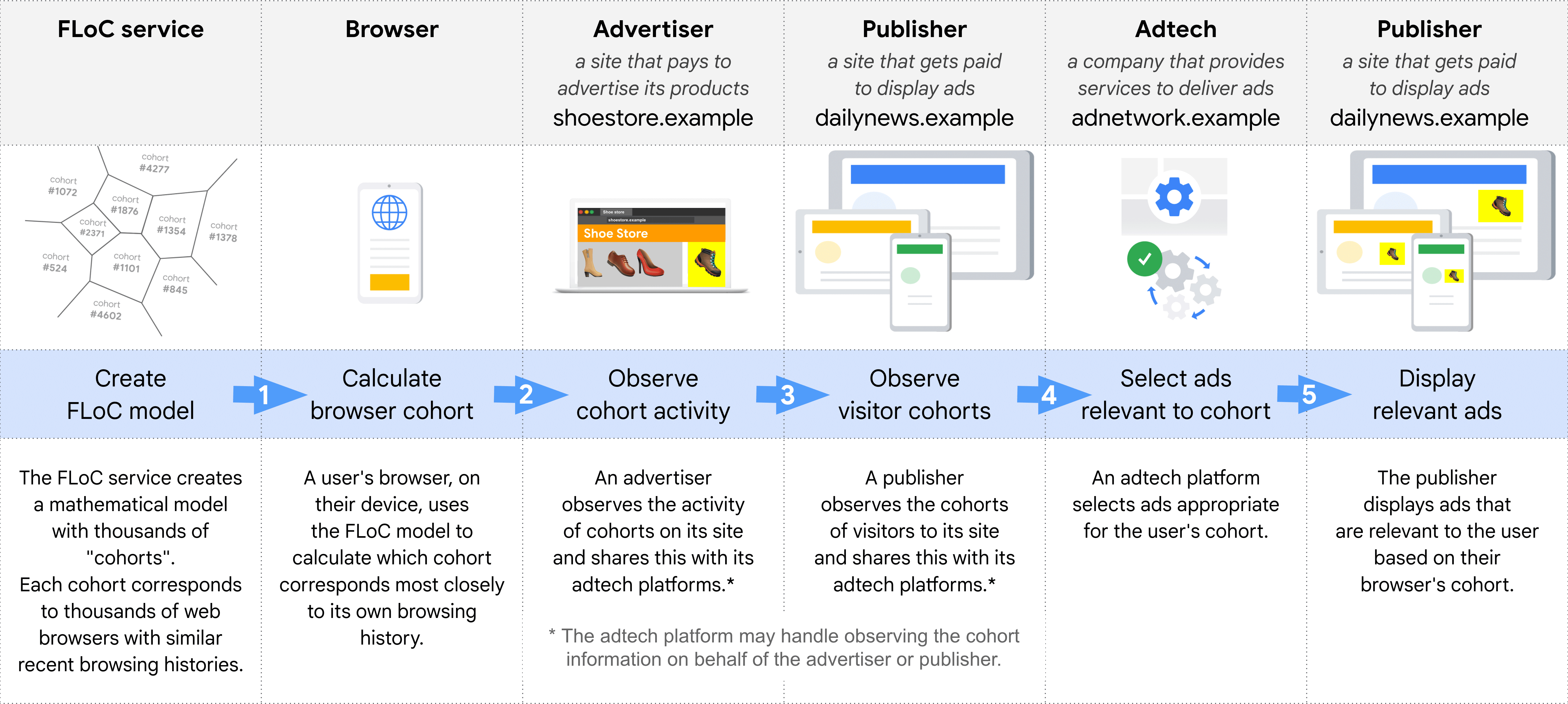
Google’s explanatory graphic for FLoC, or Federated Learning of Cohorts.
As Google developed its replacement for third-party cookies, the path grew trickier and the space more perilous. The Electronic Frontier Foundation described Google’s FLoC, or the “Federated Learning of Cohorts” that would let Chrome machine-learn your profile for sites and ads, as “A Terrible Idea.” The EFF was joined by Mozilla, Apple, WordPress, DuckDuckGo, and lots of browsers based on Chrome’s core Chromium code in being either opposed or non-committal to FLoC. Google pushed back testing FLOC until late 2022 and third-party cookie removal (and thereby FLoC implementation) until mid-2023.
By early 2022, FLoC didn’t have a path forward. Google pivoted to a Topics API, which would give users a bit more control over which topics (“Rock Music,” “Auto & Vehicles”) would be transmitted to potential advertisers. It would certainly improve over third-party cookies, which are largely inscrutable in naming and offer the user only one privacy policy: block them, or delete them all and lose lots of logins.