
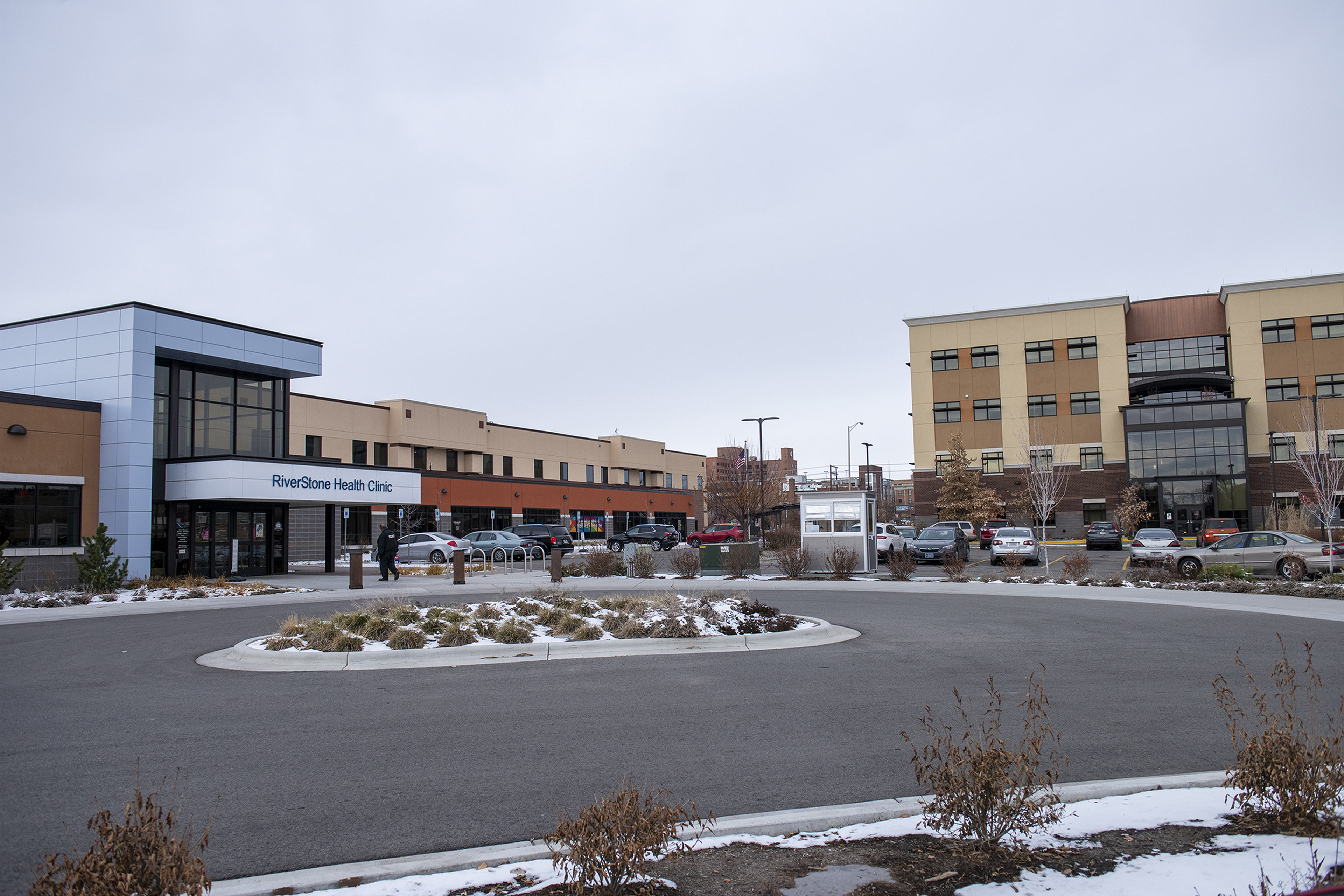
One of Montana’s largest health clinics that serves people in poverty has cut back services and laid off workers. The retrenchment mirrors similar cuts around the country as safety-net health centers feel the effects of states purging their Medicaid rolls.
Billings-based RiverStone Health is eliminating 42 jobs this spring, cutting nearly 10% of its workforce. The cuts have shuttered an inpatient hospice facility, will close a center for patients managing high blood pressure, and removed a nurse who worked within rural schools. It also reduced the size of the clinic’s behavioral health care team and the number of staffers focused on serving people without housing.
RiverStone Health CEO Jon Forte said clinic staffers had anticipated a shortfall as the cost of business climbed in recent years. But a $3.2 million loss in revenue, which he largely attributed to Montana officials disenrolling a high number of patients from Medicaid, pushed RiverStone’s deficit much further into the red than anticipated.
“That has just put us in a hole that we could not overcome,” Forte said.
RiverStone is one of nearly 1,400 federally funded clinics in the U.S. that adjust their fees based on what individuals can pay. They’re designed to reach people who face disproportionate barriers to care. Some are in rural communities, where offering primary care can come at a financial loss. Others concentrate on vulnerable populations falling through cracks in urban hubs. Altogether, these clinics serve more than 30 million people.
The health centers’ lifeblood is revenue received from Medicaid, the state-federal subsidized health coverage for people with low incomes or disabilities. Because they serve a higher proportion of low-income people, the federally funded centers tend to have a larger share of patients on the program and rely on those reimbursements.
But Medicaid enrollment is undergoing a seismic shift as states reevaluate who is eligible for it, a process known as the Medicaid “unwinding.” It follows a two-year freeze on disenrollments that protected people’s access to care during the covid public health emergency.
As of May 23, more than 22 million people had lost coverage, including about 134,000 in Montana — 12% of the state’s population. Some no longer met income eligibility requirements, but the vast majority were booted because of paperwork problems, such as people missing the deadline, state documents going to outdated addresses, or system errors.
That means health centers increasingly offer care without pay. Some have seen patient volumes drop, which also means less money. When providers like RiverStone cut services, vulnerable patients have fewer care options.
Jon Ebelt, communications director of the Montana Department of Public Health and Human Services, said the agency isn’t responsible for individual organizations’ business decisions. He said the state is focused on maintaining safety-net systems while protecting Medicaid from being misused.
Nationwide, health centers face a similar problem: a perfect financial storm created by a sharp rise in the cost of care, a tight workforce, and now fewer insured patients. In recent months, clinics in California and Colorado have also announced cuts.
“It’s happening in all corners of the country,” said Amanda Pears Kelly, CEO of Advocates for Community Health, a national advocacy group representing federally qualified health centers.
Nearly a quarter of community health center patients who rely on Medicaid were cut from the program, according to a joint survey from George Washington University and the National Association of Community Health Centers. On average, each center lost about $600,000.
One in 10 centers either reduced staff or services, or limited appointments.
“Health centers across the board try to make sure that the patients know they’re still there,” said Joe Dunn, senior vice president for public policy and advocacy at the National Association of Community Health Centers.
Most centers operate on shoestring budgets, and some started reporting losses as the workforce tightened and the cost of business spiked.
Meanwhile, federal assistance — money designed to cover the cost of people who can’t afford care —remained largely flat. Congress increased those funds in March to roughly $7 billion over 15 months, though health center advocates said that still doesn’t cover the tab.
Until recently, RiverStone in Montana had been financially stable. Before the pandemic, the organization was making money, according to financial audits.
In summer 2019, a $10 million expansion was starting to pay off. RiverStone was serving more patients through its clinic and pharmacy, a revenue increase that more than offset increases in operating costs, according to documents.
But in 2021, at the height of the pandemic, those growing expenses — staff pay, building upkeep, the price of medicine, and medical gear — outpaced the cash coming in. By last summer, the company had an operational loss of about $1.7 million. With the Medicaid redetermination underway, RiverStone’s pool of covered patients shrank, eroding its financial buffer.
Forte said the health center plans to ask state officials to increase its Medicaid reimbursement rates, saying existing rates don’t cover the continuum of care. That’s a tricky request after the state raised its rates slightly last year following much debate around which services needed more money.
Some health center cuts represent a return to pre-pandemic staffing, after temporary federal pandemic funding dried up. But others are rolling back long-standing programs as budgets went from stretched to operating in the red.
California’s Petaluma Health Center in March laid off 32 people hired during the pandemic, The Press Democrat reported, or about 5% of its workforce. It’s one of the largest primary care providers in Sonoma County, where life expectancy varies based on where people live and poverty is more prevalent in largely Hispanic neighborhoods.
Clinica Family Health, which has clinics throughout Colorado’s Front Range, laid off 46 people, or about 8% of its staff, in October. It has consolidated its dental program from three clinics to two, closed a walk-in clinic meant to help people avoid the emergency room, and ended a home-visit program for patients recently discharged from the hospital.
Clinica said 37% of its patients on Medicaid before the unwinding began lost their coverage and are now on Clinica’s discount program. This means the clinic now receives between $5 and $25 for medical visits that used to bring in $220-$230.
“If it’s a game of musical chairs, we’re the ones with the last chair. And if we have to pull it away, then people hit the ground,” said CEO Simon Smith.
Stephanie Brooks, policy director of the Colorado Community Health Network, which represents Colorado health centers, said some centers are considering consolidating or closing clinics.
Colorado and Montana have among the nation’s highest percentages of enrollment declines. Officials in both states have defended their Medicaid redetermination process, saying most people dropped from coverage likely no longer qualify, and they point to low unemployment rates as a factor.
In many states, health providers and patients alike have provided examples in which people cut from coverage still qualified and had to spend months entangled in system issues to regain access.
Forte, with RiverStone, said reducing services on the heels of a pandemic adds insult to injury, both for health care workers who stayed in hard jobs and for patients who lost trust that they’ll be able to access care.
“This is so counterproductive and counterintuitive to what we’re trying to do to meet the health care needs of our community,” Forte said.
KFF Health News correspondent Rae Ellen Bichell in Longmont, Colorado, contributed to this report.